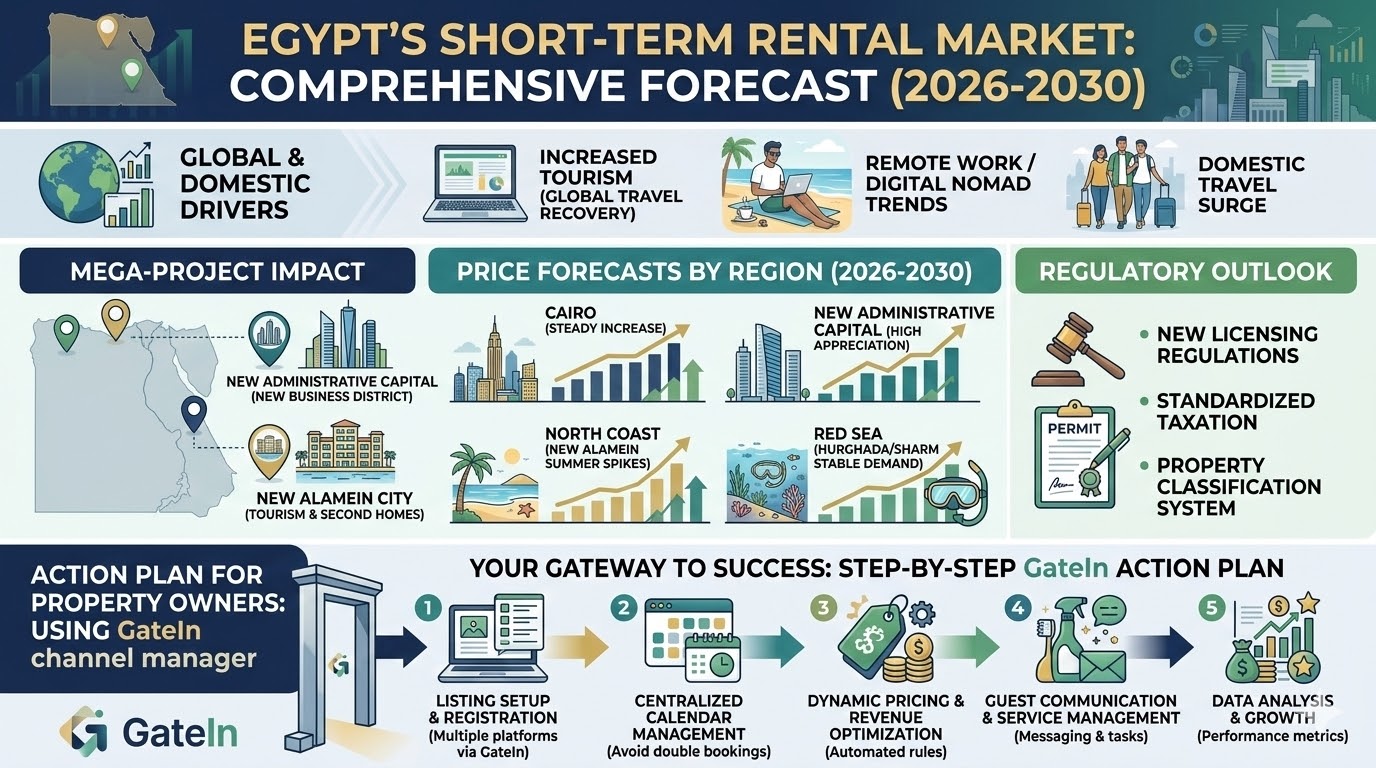
Egypt's short-term rental market is in the midst of a profound transformation. What began as a niche segment of the hospitality industry — a few savvy property owners listing their Cairo apartments on Airbnb — has evolved into a mainstream investment category attracting serious capital, professional operators, and sophisticated guests from around the world. As we look toward the horizon of 2026–2030, the opportunities are extraordinary, but so are the challenges facing hosts who fail to adapt.
This comprehensive guide examines the forces shaping Egypt's short-term rental future: the mega-projects redefining Egypt's geography, the behavioral shifts transforming how travelers choose accommodation, the technological revolution making professional hosting accessible to individual owners, and the regulatory landscape that will increasingly define who thrives in this market. Whether you own a studio apartment in New Cairo or a beachfront villa in Hurghada, understanding these trends — and acting on them now — will determine your financial outcomes over the next five years.
The Current State of Egypt's Short-Term Rental Market
Before projecting into the future, let's ground ourselves in the present reality. Egypt's short-term rental market has achieved remarkable scale in a remarkably short time. The combination of post-pandemic travel recovery, Egypt's aggressive tourism infrastructure investments, and the global rise of the "work from anywhere" movement has created a perfect storm of demand.
| Market Indicator | Current Status (2025–2026) | Year-on-Year Change |
|---|---|---|
| Active listings on Airbnb in Egypt | 45,000+ active units | +28% vs. 2023 |
| Annual booking growth rate | +22% annually on average | Accelerating |
| International tourist arrivals | Surpassed 15 million in 2024 | +19% vs. 2023 |
| Average peak season occupancy | 65–85% in major coastal markets | Stable to increasing |
| Share of travelers preferring apartments over hotels | 41% globally, higher for longer stays | +6 percentage points since 2020 |
| Average nightly rate (Egypt, furnished apartment) | $75–$160 USD | +15% vs. 2023 |
These numbers tell a clear story: Egypt's short-term rental market is growing rapidly from a strong base. But the most interesting chapter hasn't been written yet — it will unfold between now and 2030.
The Five Major Forces Shaping Egypt's Rental Future
Force 1: The Remote Work Revolution is Permanent
The COVID-19 pandemic forced remote work adoption on a global scale. What was initially a temporary accommodation has become a permanent feature of the global economy. An estimated 35+ million digital nomads now work remotely from locations of their choosing, and this number is growing at 30–40% annually. Many of these professionals are actively seeking destinations that combine affordable cost of living, good internet connectivity, pleasant weather, and cultural richness — a description that fits Egypt remarkably well.
For property owners, this trend has profound implications. Remote workers and digital nomads represent a qualitatively different type of guest from traditional vacation tourists. They stay longer (typically 1–3 months vs. 5–7 days for vacation tourists), spend more locally (they cook, shop, use local services), cause less property wear per month than short-stay guests, and are typically higher earners with foreign currency incomes that translate to strong purchasing power in Egypt.
Properties that are configured to serve this audience — with fast fiber internet, a proper ergonomic workspace, a fully equipped kitchen, and flexible monthly pricing — can command a 50–120% premium over traditional long-term lease rates while maintaining the flexibility of short-term rental operations.
Force 2: Egypt's Mega-Projects Are Creating Entirely New Markets
Egypt is in the midst of the most ambitious construction and infrastructure program in its modern history. Several mega-projects are either already creating new rental demand or will do so within the 2026–2030 window:
| Project | Location | Expected Impact on Short-Term Rentals | Timeline |
|---|---|---|---|
| New Administrative Capital (NAC) | 45km east of Cairo | Massive business travel demand; government employees and contractors | Already active, growing through 2030 |
| New Alamein City | Mediterranean coast | Major European and Gulf tourism destination; resort-style rentals | Rapid growth 2026–2029 |
| Ras El-Hekma Development | North Coast | $35B UAE-backed investment; high-end resort tourism | 2026–2030 peak development |
| Luxor-Aswan Tourism Corridor | Upper Egypt | Cultural tourism renaissance; boutique and heritage rentals | Ongoing infrastructure upgrades |
| Grand Egyptian Museum | Giza | Draws premium international tourists to Greater Cairo area | Now open, tourism benefits building |
| Hurghada Airport Expansion | Red Sea | Increased capacity = more international arrivals = more rental demand | Ongoing expansion |
Force 3: The Technology Democratization of Professional Hosting
Until recently, managing a short-term rental property professionally required either dedicating significant personal time or hiring a costly property management company. Smart locks, automated messaging platforms, dynamic pricing tools, and channel managers have fundamentally changed this equation. Today, a single individual can manage 5–10 properties across 6 booking platforms from their smartphone, with most guest interactions automated.
This technological democratization is accelerating. By 2028, AI-powered tools will handle the vast majority of routine host tasks: pricing optimization, inquiry responses, review management, maintenance scheduling, and guest communication. The hosts who embrace these tools now are building the operational foundation that will allow them to scale their portfolios without proportionally scaling their time investment.
Force 4: Increasingly Sophisticated Guest Expectations
The profile of the short-term rental guest is evolving rapidly. Younger travelers (Gen Z and Millennials, who now represent the majority of leisure travelers) have grown up with curated digital experiences and have little tolerance for properties that don't meet their expectations. They research extensively before booking, scrutinize photos and reviews in detail, and will quickly leave a negative review if the experience doesn't match the listing.
These guests expect: professional photography that accurately represents the space, instant response to inquiries (within one hour), seamless self-check-in with no scheduling friction, flawless WiFi connectivity, thoughtful touches that elevate the stay beyond a generic hotel room, and a host who is responsive but not intrusive.
Properties that consistently deliver this experience earn Superhost status, better search rankings, and can charge 15–25% premiums over comparable unlisted competitors. Properties that don't will gradually lose market share as the competition improves.
Force 5: Regulatory Formalization is Coming
Egypt is following a global trend toward regulating short-term rentals. Cities from Barcelona to Amsterdam to New York have implemented licensing requirements, minimum stay rules, and density caps. While the specific form and timeline of Egyptian regulation is uncertain, the direction of travel is clear. Property owners who proactively build compliant, professionally operated rental businesses now will face far less disruption when regulations take effect than those who are caught unprepared.
Short-Term Rental Price Forecasts by Region (2025–2030)
Based on current market trends, infrastructure investments, and demand projections, here are realistic price growth forecasts for Egypt's key rental markets:
| Region | Average Nightly Rate 2025 | Forecast 2027 | Forecast 2030 | CAGR |
|---|---|---|---|---|
| New Cairo / 5th Settlement | $80–$150 | $100–$190 | $130–$250 | ~10% |
| Hurghada (beachfront villas) | $100–$200 | $130–$260 | $170–$350 | ~12% |
| Sharm el-Sheikh (resort zones) | $90–$180 | $115–$230 | $150–$300 | ~11% |
| New Alamein City | $70–$130 (emerging) | $120–$220 | $160–$300 | ~18% |
| Ras El-Hekma | $80–$150 | $140–$260 | $180–$340 | ~17% |
| El Gouna | $120–$250 | $150–$310 | $190–$400 | ~10% |
| Luxor / Aswan | $50–$100 | $70–$140 | $95–$185 | ~13% |
The Best Investment Opportunities in Egypt's Short-Term Rental Market
Highest Growth Potential: North Coast Developments
Ras El-Hekma and New Alamein represent the highest potential growth markets in Egypt's short-term rental landscape through 2030. The $35 billion UAE investment in Ras El-Hekma is fundamentally repositioning this stretch of Mediterranean coastline as a world-class resort destination, with infrastructure, retail, and hospitality developments that will attract affluent European, Gulf, and Egyptian premium travelers. Properties purchased in the current development phase at current prices have the potential for significant capital appreciation alongside strong rental income.
New Alamein is further along in its development trajectory with existing infrastructure and growing tourism numbers. The city offers a compelling combination of Mediterranean climate, modern facilities, and proximity to Alexandria (roughly 130km) that makes it appealing for both weekend getaways from Cairo and Alexandria and longer international stays.
Most Stable Returns: Established Red Sea Markets
Hurghada and Sharm el-Sheikh offer what property investors call "stable" returns — lower growth rates than emerging markets but much lower risk. These destinations have proven demand from European charter tourism, growing dive and water sports communities, and increasingly, a digital nomad population attracted by the sunny climate and lower cost of living. A well-maintained, professionally listed property in either market can realistically achieve 70–80% occupancy over a 12-month period with appropriate seasonal pricing.
Best for Business Rental Income: New Administrative Capital
The New Administrative Capital is creating an entirely new type of short-term rental demand in Egypt: business accommodation for government officials, contractors, consultants, and corporate employees who need temporary accommodation near Egypt's new seat of government. This demand is remarkably stable across seasons (business travel doesn't slow down in summer the way leisure travel does) and comes from guests with corporate expense accounts willing to pay premiums for well-located, professionally equipped properties.
Three Types of Hosts Who Will Win in 2030
Type 1: The Technology-Forward Multi-Property Operator
This host has embraced every available technology tool — channel manager, dynamic pricing, automated messaging, smart locks, professional photography — and uses them to manage a portfolio of 3–10 properties across multiple markets with minimal personal time investment. They're listed on 6–8 platforms simultaneously, maintain near-perfect review scores through process consistency, and generate significantly higher revenue per property than manually-operated competitors.
The key enabler for this host type is a reliable channel manager. Without one, managing multiple platforms across multiple properties is operationally impossible. GateIn provides exactly this capability — connecting 150+ booking platforms with real-time calendar synchronization, unified messaging, and revenue analytics, all on a free-forever plan for individual property owners.
Type 2: The Premium Niche Specialist
This host has identified a specific type of traveler — digital nomads, honeymooners, diving enthusiasts, heritage culture seekers — and has designed their property and hosting experience specifically around that guest profile. They charge above-market rates justified by a genuinely exceptional, differentiated experience. Their repeat guest rate is high, their reviews are enthusiastic, and their occupancy is driven more by word of mouth and referrals than by platform algorithms.
Type 3: The Compliant Professional Host
When Egyptian regulations formalize, this host will have a head start. They maintain proper documentation, declare rental income correctly, understand their tax obligations, have their properties registered with relevant authorities, and can demonstrate compliance on request. As regulations tighten, non-compliant hosts will face fines, delisting, or forced exit from the market — giving compliant hosts a competitive windfall as supply contracts.
What You Need to Do Right Now to Prepare
The 2026–2030 opportunity window is open, but it won't be open forever. Competition is intensifying, guest expectations are rising, and the technological tools that will define the next generation of successful hosts are available today. Here is a practical action plan organized by urgency:
Immediate Actions (Next 30 Days)
- Audit your internet connection: If you don't have a minimum 50 Mbps fiber connection, contact your ISP today. This is the single highest-ROI investment you can make for the remote worker market.
- Professional photography: If your listing photos are more than one year old or were taken with a smartphone, book a professional photographer. Good photos typically increase bookings by 20–40%.
- Multi-platform listing: If you're on only one platform, sign up for at least two more this month. Airbnb + Booking.com is the minimum; add a third platform (Flatio, Vrbo, or a regional platform) for additional reach.
- Channel manager setup: As soon as you're on multiple platforms, set up a channel manager to prevent double-bookings. GateIn offers a free forever plan — there is no reason to delay this.
Short-Term Actions (Next 3–6 Months)
- Workspace setup: Add an ergonomic desk and chair if you don't have one. Budget EGP 3,000–8,000 for a quality setup — it pays for itself in one extended nomad booking.
- Smart lock installation: Eliminate the key-handoff problem permanently. Cost-effective smart locks start at EGP 1,500–2,500.
- Automated messaging: Write and schedule pre-arrival, day-of-arrival, and checkout message templates. This dramatically reduces your time investment per guest while improving their experience.
- Monthly pricing strategy: Set up dedicated monthly discount tiers on all platforms (15% for 7+ nights, 25% for 14+ nights, 35% for 28+ nights) to attract the longer-stay remote worker segment.
Medium-Term Actions (6–18 Months)
- Dynamic pricing tool: Integrate a pricing optimizer that adjusts your rates based on local demand, competitor pricing, and seasonal patterns. This alone typically increases annual revenue by 15–25%.
- Review building strategy: Aim for 50+ reviews with a 4.8+ rating. Properties with this profile have dramatically better search visibility and conversion rates on all platforms.
- Financial compliance setup: Establish a system for tracking rental income and expenses. Consult a local accountant familiar with rental income taxation.
- Property differentiation: Identify your target guest profile and invest in 2–3 features that make your property uniquely appealing to that profile (pool access, sea view, cultural décor, studio equipment, etc.).
Common Mistakes Hosts Make Planning for the Future
| Mistake | Why It's Costly | The Right Approach |
|---|---|---|
| Staying on only one platform | Single platform changes (algorithm, fees, policy) can devastate revenue overnight | List on 5–8 platforms with a channel manager |
| Static "set and forget" pricing | Leaves significant revenue on the table during high demand periods | Dynamic pricing adjusted for seasons, events, competitor rates |
| Ignoring the nomad/remote worker segment | Missing the fastest-growing, highest-LTV guest segment | Invest in workspace, fast WiFi, monthly discounts |
| Underinvesting in photography | Poor photos are the #1 reason listings underperform algorithmically | Professional photography every 12–18 months |
| No contingency planning for regulation | Sudden rule changes can shut down unregistered operations | Build compliance into your operations proactively |
| Operating without a channel manager | Double bookings, manual calendar management, missed inquiries | Set up GateIn or similar tool before listing on multiple platforms |
Frequently Asked Questions
Will the short-term rental market in Egypt become oversaturated by 2030?
Specific geographic pockets may see oversupply, particularly in popular coastal areas where development is concentrated. However, the overall market is expected to remain undersupplied relative to demand, especially in emerging markets like Ras El-Hekma and New Alamein. The key is differentiation — the market will punish undifferentiated, poorly managed properties while rewarding quality and professionalism regardless of supply levels.
Will Egyptian regulations make short-term renting less profitable?
Regulations typically add compliance costs but also create competitive advantages for compliant operators. When non-compliant properties are forced to exit the market, the supply reduction benefits remaining properties through higher occupancy and prices. The net effect for professional, compliant hosts is often neutral to positive. Build your operations to be regulation-ready from day one.
Is it better to focus on one city or diversify across multiple markets?
For smaller operators (1–3 properties), concentrating in one well-chosen market allows you to develop deep local expertise and operational efficiency. For larger operators, geographic diversification reduces exposure to city-specific events (political unrest, bad weather seasons, local economic shocks). The right answer depends on your scale, risk tolerance, and management infrastructure.
How many platforms should I be listed on in 2026 and beyond?
The minimum viable presence is 3 platforms (Airbnb + Booking.com + one specialist platform). The optimal range for most properties is 5–8 platforms, managed through a channel manager like GateIn to prevent double-bookings. Each additional platform represents a cost-free expansion of your distribution reach.
What's the single most important investment I can make in my property today?
If your internet connection isn't fiber-speed (100+ Mbps), that's your highest-priority investment. If your internet is already strong, professional photography is the second-highest ROI improvement. Both have immediate, measurable impacts on booking rates and the types of guests you attract.
Future-Proof Your Egyptian Property with GateIn
The 2026–2030 short-term rental opportunity in Egypt is real, but capturing it requires the right infrastructure. At the center of that infrastructure is a professional channel manager that keeps your listings synchronized across every platform, automates your availability management, and gives you the data to make intelligent pricing decisions.
GateIn connects your Egyptian property to 150+ global booking platforms with real-time synchronization — eliminating double bookings, maximizing your distribution reach, and freeing your time for the higher-value activities that will differentiate your property in an increasingly competitive market. The free forever plan means there is no barrier to getting started. Visit gatein.ae today and build the foundation for your most profitable rental years ahead.