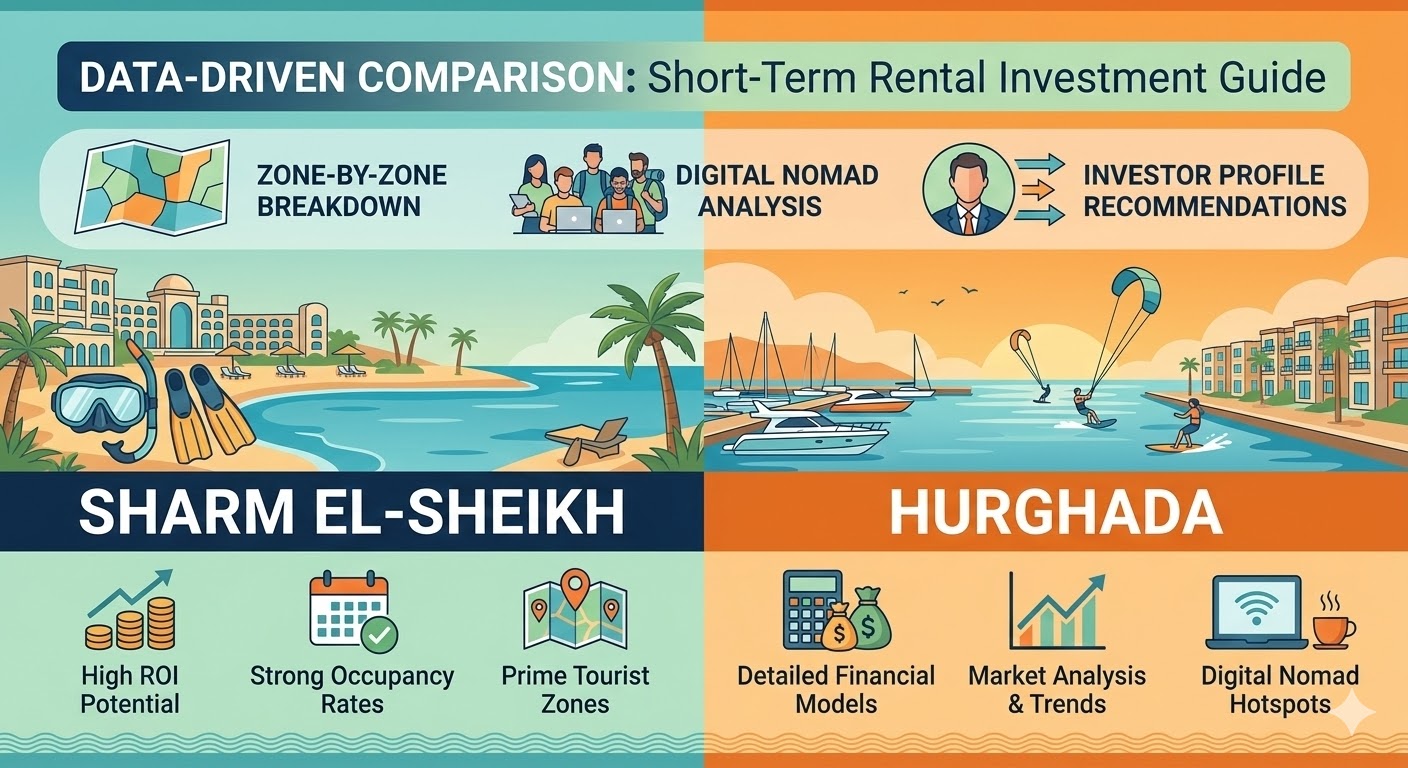
It is one of the most debated questions among Egyptian and Gulf property investors: Sharm el-Sheikh or Hurghada? Both are world-class beach destinations on Egypt's most coveted coastlines, both attract millions of international tourists annually, and both offer compelling short-term rental investment opportunities. But they are fundamentally different markets serving different audiences — and the right choice between them depends entirely on your investment goals, budget, risk tolerance, and target guest profile.
Making the wrong choice could mean years of underperforming returns. Making the right one could deliver a net annual yield of 12–18% on a property that also appreciates significantly in capital value over your holding period. This comprehensive guide puts both destinations under the microscope with detailed financial analysis, market data, guest profile comparisons, regional breakdowns, and scenario-based recommendations to help you make your decision with confidence.
The Fundamental Difference: Two Destinations, Two Identities
Before diving into numbers, it is essential to understand the core identity of each destination — because that identity drives every financial metric that follows.
Sharm el-Sheikh has positioned itself as Egypt's premier international resort city. Anchored on the tip of the Sinai Peninsula where the Gulf of Aqaba meets the Red Sea, Sharm attracts high-spending tourists seeking a full-service resort experience. It has hosted world leaders (COP27 climate conference, Middle East peace summits), maintains an exceptional concentration of five-star hotel and resort infrastructure, and serves a guest profile that leans toward wealthier travelers willing to pay premium rates for premium experiences.
Hurghada is Egypt's most-connected international gateway and the diving capital of the Red Sea. With more direct international flights than any other Egyptian airport, Hurghada brings in a broader demographic — European charter tourists, diving enthusiasts, families on package holidays, and an increasingly significant community of digital nomads and long-term residents. The city has genuine urban DNA beyond the tourist zone, with local neighborhoods, markets, and a resident population that provides demand independent of international tourism.
| Dimension | Sharm el-Sheikh | Hurghada |
|---|---|---|
| Location | South Sinai, Gulf of Aqaba | Red Sea Governorate, western Red Sea coast |
| Tourism identity | Luxury resort, international conferences | Global diving destination, family holidays |
| Primary source markets | Russia, Western Europe, Gulf states | Western Europe, Russia, Egyptian domestic |
| Annual tourist volume | 8–10 million visitors | 6–8 million visitors |
| Sea conditions | Gulf of Aqaba (calmer, protected) | Open Red Sea (windier, reef-rich) |
| Seasonality | More even year-round distribution | Strong European winter, quieter summer |
| International flights | 200+ direct international routes | 300+ direct routes (Egypt's busiest) |
| Digital nomad community | Moderate and growing | Strong and rapidly growing |
| Property price entry point | Higher ($70,000–$120,000 for studio) | Lower ($40,000–$80,000 for studio) |
Sharm el-Sheikh: Deep Dive
The Tourism Economy
Sharm el-Sheikh's tourism economy is sophisticated and diversified in ways that most beach destinations are not. Beyond the standard beach holiday market, the city hosts a substantial MICE (Meetings, Incentives, Conferences, Exhibitions) segment, drawing corporate groups and government delegations to its world-class convention center facilities. This business travel segment provides a meaningful counterbalance to leisure tourism's seasonal fluctuations — business conferences happen year-round, including in summer months when leisure tourists thin out.
The Gulf Arab market is another pillar of Sharm's economy that Hurghada does not replicate to the same degree. Saudi, Emirati, Qatari, and Kuwaiti tourists flock to Sharm during summer months — escaping their own extreme summer heat — at precisely the time when European charter tourists are less numerous. This provides a natural seasonal complement that helps maintain occupancy through Egypt's hottest months.
Key Investment Zones in Sharm el-Sheikh
Understanding where to buy within Sharm matters as much as the decision to invest in Sharm at all. The city has several distinct zones with very different characteristics:
| Zone | Character | Price per m² | Avg. Nightly Rate | Best For |
|---|---|---|---|---|
| Naama Bay | Heart of nightlife, shopping, dining | EGP 18,000–30,000 | $120–$250 | Young couples, solo travelers |
| Hadaba (Old Sharm) | Quieter, residential feel, budget tourists | EGP 10,000–18,000 | $70–$130 | Budget-conscious European tourists |
| Soho Square / Montazah | Upscale gated compounds, hotel amenities | EGP 22,000–40,000 | $150–$350 | Families, Gulf tourists, premium renters |
| South Sharm (Ras Um Sid) | Exclusive villas, world-class diving | EGP 25,000–55,000 | $200–$500 | Luxury divers, honeymooners |
| Nabq Bay | Newer area, large all-inclusive resorts | EGP 15,000–25,000 | $100–$200 | Families, package holiday seekers |
Financial Case for Sharm el-Sheikh
Let's build a concrete financial model for a representative Sharm investment — an 80m² furnished apartment with partial sea view in the Soho Square / Montazah area:
- Purchase price: EGP 2,800,000 (approximately $93,000 at current rates)
- Furnishing and setup: EGP 150,000 ($5,000)
- Total investment: EGP 2,950,000 ($98,000)
- Average nightly rate (blended annual): $150
- Annual occupancy rate: 68%
- Gross annual rental income: $150 × 365 × 0.68 = $37,230
- Platform fees + operating costs (25%): -$9,307
- Net annual rental income: ~$27,900
- Net yield on total investment: ~28.4% (in USD terms vs. EGP purchase price)
- 5-year capital appreciation forecast: +50–60% on purchase price
Hurghada: Deep Dive
The Tourism Economy
Hurghada's economy is powered by something no other Egyptian city can match: the world's most biodiverse and accessible coral reef ecosystem. The reefs surrounding Hurghada and the nearby islands of the Brothers, Daedalus, and Abu Nuhas are bucket-list diving destinations that bring passionate divers from Germany, the UK, France, Poland, and beyond specifically to Hurghada — regardless of broader tourism trends. This niche market provides a resilient demand base that insulates the city from some of the broader tourism volatility that affects more generic beach destinations.
Beyond diving, Hurghada has become Egypt's most internationally connected coastal city. Over 300 direct international routes serve Hurghada International Airport, the majority being charter flights from European cities bringing package tourists who fill the city's extensive resort complex infrastructure. This massive air connectivity ensures a steady pipeline of international tourists across the peak season months from November through April.
Perhaps most significantly for the next decade, Hurghada is becoming a genuine digital nomad hub. The combination of affordable furnished apartments, improving fiber internet infrastructure, a warm winter climate, stunning natural beauty, and a growing community of European and international remote workers has created a virtuous cycle — nomads find Hurghada, tell their networks, and more nomads follow. This segment spends more per month than traditional tourists, stays longer, and generates more stable year-round income for hosts who configure their properties appropriately.
Key Investment Zones in Hurghada
| Zone | Character | Price per m² | Avg. Nightly Rate | Best For |
|---|---|---|---|---|
| El Gouna | Self-contained luxury resort town, marina | EGP 20,000–45,000 | $130–$400 | Premium Europeans, long stays, nomads |
| Sakala / New Hurghada | Balanced amenities and pricing | EGP 12,000–22,000 | $80–$160 | Value-seeking Europeans, families |
| Sahl Hasheesh | Upscale resort community, private beach | EGP 18,000–35,000 | $120–$300 | Luxury seekers, couples, Gulf tourists |
| Soma Bay | Exclusive peninsula resort, world-class spa | EGP 25,000–50,000 | $200–$500 | Ultra-premium, honeymoon, wellness |
| Hadayek / Dahar | Local neighborhoods, authentic Egypt feel | EGP 7,000–14,000 | $50–$100 | Budget travelers, young divers |
Financial Case for Hurghada
Let's build the equivalent financial model for Hurghada — an 80m² furnished apartment with partial sea view in the Sakala area:
- Purchase price: EGP 1,800,000 (approximately $60,000)
- Furnishing and setup: EGP 120,000 ($4,000)
- Total investment: EGP 1,920,000 ($64,000)
- Average nightly rate (blended annual): $110
- Annual occupancy rate: 65%
- Gross annual rental income: $110 × 365 × 0.65 = $26,097
- Platform fees + operating costs (25%): -$6,524
- Net annual rental income: ~$19,573
- Net yield on total investment: ~30.6% (in USD terms vs. EGP purchase price)
- 5-year capital appreciation forecast: +55–80% on purchase price (higher growth potential from lower base)
Side-by-Side Financial Comparison
| Financial Metric | Sharm el-Sheikh | Hurghada | Winner |
|---|---|---|---|
| Average purchase price (80m²) | EGP 2.2–3.5M | EGP 1.5–2.5M | Hurghada (lower entry) |
| Average monthly income (peak season) | $4,500–$7,000 | $3,000–$5,500 | Sharm (higher nightly rates) |
| Annual occupancy rate (average) | 62–72% | 58–70% | Sharm (marginally more stable) |
| Net rental yield (annual) | 8–12% (EGP terms) | 10–15% (EGP terms) | Hurghada (better ratio) |
| 5-year capital appreciation forecast | +40–60% | +55–80% | Hurghada (higher upside) |
| Off-season income stability | Better (Gulf summer tourists) | Moderate (nomads offset gap) | Sharm |
| Geopolitical risk exposure | Higher (Sinai location) | Lower | Hurghada |
| Digital nomad rental premium | Moderate | High and growing | Hurghada |
Seasonality Analysis: When Does Each City Fill Up?
Understanding seasonality is critical for cash flow planning. Both cities have seasonal demand patterns, but the shape of those patterns differs significantly:
| Month | Sharm el-Sheikh Occupancy | Hurghada Occupancy |
|---|---|---|
| January – March | 80–90% (European winter sun) | 85–95% (peak European charter) |
| April – May | 70–80% (spring break) | 65–75% (shoulder season) |
| June – August | 60–75% (Gulf tourists + Eid) | 40–55% (quieter European summer) |
| September – October | 65–75% (early winter bookings) | 55–70% (shoulder, nomads arriving) |
| November – December | 80–90% (European winter peak) | 80–92% (best season, holidays) |
The key takeaway: Hurghada achieves higher peak occupancy (up to 92–95% in its best months) but has a more pronounced low season in summer. Sharm achieves more even year-round occupancy thanks to Gulf tourism filling the European summer gap. For investors who need stable monthly cash flow, Sharm is more predictable. For investors willing to optimize around peaks, Hurghada's peaks are higher.
The Digital Nomad Factor: A Growing Advantage for Hurghada
One trend that is reshaping the competitive dynamics between these two cities deserves special attention: the digital nomad movement.
Hurghada has become Egypt's most compelling digital nomad destination, and the gap with Sharm is widening. The reasons are structural: Hurghada's cost of living is lower, its international community is larger, co-working spaces have proliferated, and the city has better year-round internet infrastructure than most Red Sea coastal towns. Digital nomad communities on Facebook and Telegram now have tens of thousands of members specifically discussing Hurghada, and the city has begun appearing on nomad ranking sites.
This matters for property investors because digital nomads fundamentally improve your year-round economics. A digital nomad booking at a 35% monthly discount still generates $2,000–$3,000 per month in stable, predictable income — during months when the vacation rental market might otherwise leave your property empty. Properties configured for nomads (fast WiFi, ergonomic workspace, monthly discount) can see their low-season occupancy increase from 40% to 65%+ through this segment alone.
Sharm is not absent from the nomad market, but its higher cost of living and smaller local community make it less attractive as a nomad base than Hurghada. This gap is likely to widen over the 2026–2030 period as the nomad community grows.
Matching Investor Profiles to the Right Destination
| Investor Profile | Recommended City | Specific Zone | Reason |
|---|---|---|---|
| First-time investor, budget under $70K | Hurghada | Sakala / New Hurghada | Lower entry, higher relative yield |
| Seeking stable year-round income | Sharm el-Sheikh | Naama Bay or Soho Square | Gulf tourists offset European summer lull |
| Targeting digital nomads and remote workers | Hurghada | El Gouna or Sakala | Established nomad community, lower COL |
| Targeting Gulf Arab tourists | Sharm el-Sheikh | Nabq Bay or South Sharm | Preferred destination for Gulf summer holidays |
| Targeting European diving enthusiasts | Hurghada | Hadayek or Sahl Hasheesh | World-class reefs bring dedicated dive market |
| Seeking maximum capital appreciation | Hurghada | El Gouna or emerging zones | Higher growth potential from lower price base |
| Luxury / premium income focus | Either | Soma Bay (Hurghada) or South Sharm | Premium beachfront commands top nightly rates |
The Critical Role of Multi-Platform Distribution
Whichever destination you choose, the fundamental economics of modern short-term rental investing require distribution across multiple booking platforms. A property listed only on Airbnb achieves perhaps 60–70% of its revenue potential. The same property listed on Airbnb + Booking.com + Vrbo + a specialist platform like Flatio or Spotahome typically achieves 85–95% of its revenue potential — a 25–40% income increase for zero additional marketing spend.
The challenge of multi-platform distribution is calendar synchronization. Without a channel manager, a booking on one platform is not automatically reflected on others — creating the risk of double-bookings, unhappy guests, and damaged reviews. This is not a theoretical risk: hosts managing two or more platforms manually experience double-booking incidents far too frequently.
GateIn solves this problem completely. As a free channel manager connecting 150+ booking platforms, GateIn synchronizes your availability in real-time across every platform where you're listed. When a booking arrives on Airbnb, those dates are immediately blocked everywhere else. When a guest cancels on Booking.com, those dates are immediately available again everywhere. The unified messaging dashboard means you never miss an inquiry regardless of which platform it came from. And the revenue analytics help you identify which platforms deliver the best-performing bookings for your specific property and location.
For a property in Sharm or Hurghada targeting both the European vacation market and the digital nomad segment, being on Airbnb (vacation rentals), Booking.com (broader European reach), Flatio (monthly stays and nomads), and one regional platform is the minimum effective distribution strategy. GateIn makes managing this four-platform presence as simple as managing a single listing.
Frequently Asked Questions
Can foreigners own property in both Sharm el-Sheikh and Hurghada?
Generally yes, though with important nuances. In Hurghada, foreigners can own property with relatively straightforward title registration. In Sharm el-Sheikh (which falls within South Sinai Governorate), there are restrictions on foreign ownership in certain zones under Egyptian law, particularly for nationals of some countries. Always verify your specific situation with a qualified Egyptian real estate lawyer before proceeding with any purchase.
Which city performs better during Egyptian national holidays?
Both perform very well during Eid holidays (domestic and Gulf tourism surges). Sharm benefits from year-round conference and corporate travel that partially fills the gap between major holidays. Hurghada benefits from large Egyptian domestic tourism in summer. For maximizing Egyptian holiday income, both are strong — Sharm slightly more so due to the Gulf market's spending power.
Is El Gouna worth the premium over central Hurghada?
El Gouna commands 30–50% higher nightly rates than comparable central Hurghada properties, and its premium guest profile tends to result in better reviews and lower turnover costs. However, the higher purchase prices mean the absolute yield differential is smaller than it might appear. El Gouna is the right choice if you want a managed, low-friction investment with a premium guest base. Central Hurghada delivers better absolute yield for value investors.
How should I handle platform management for my property?
Use a channel manager from day one. GateIn offers a free forever plan that connects your property to 150+ platforms. Set up your listing on at least 3–4 platforms simultaneously, configure your monthly discount tiers, and let the channel manager keep everything synchronized. This setup takes a few hours initially and saves hundreds of hours of manual management over the life of your investment.
Maximize Returns in Sharm or Hurghada with GateIn
Whether your analysis leads you to Sharm el-Sheikh or Hurghada, the next step is the same: get your property distributed across multiple platforms and managed professionally. GateIn is the free channel manager that connects Egyptian property owners to 150+ global booking platforms — synchronizing your availability automatically, managing all guest communications from a single inbox, and providing the analytics you need to optimize your pricing and platform mix. Start for free at gatein.ae and build the distribution foundation that turns a good Egyptian beach investment into an exceptional one.